
Running a Sex Offender Check in Hawaii County
The Hawaiʻi Sex Offender and Other Covered Offender Registry is the authoritative online channel for Hawaii County registry records. The Hawaii Criminal Justice Data Center, part of the Department of the Attorney General, maintains it under chapter 846E. Searchers can use a name or location and then read the matching public profile. The islandwide Hawaiʻi Police Department does not publish a separate city or county registry.
A Hawaii County offender check should begin with enough detail to distinguish a person or place. Names may have aliases. Postal cities such as Hilo and Kailua-Kona are useful search filters, but they are not incorporated police jurisdictions. Address results should be checked against the profile's status, offense jurisdiction, and update information. If a person or address may cross state lines, add the national search rather than assuming the Hawaiʻi portal covers mainland records.
Hawaii County Covered Offenders
Hawaiʻi law uses “covered offender,” a term broader than the familiar sex-offender label. The registry can include a sex offender or an offender against a minor when chapter 846E makes the person subject to registration. This wording explains why the public form includes an Offender Type control with All, Sex Offender, and Offender Against Minor choices.
The HCJDC covered-offender program page supplies the state office contact and official program context.
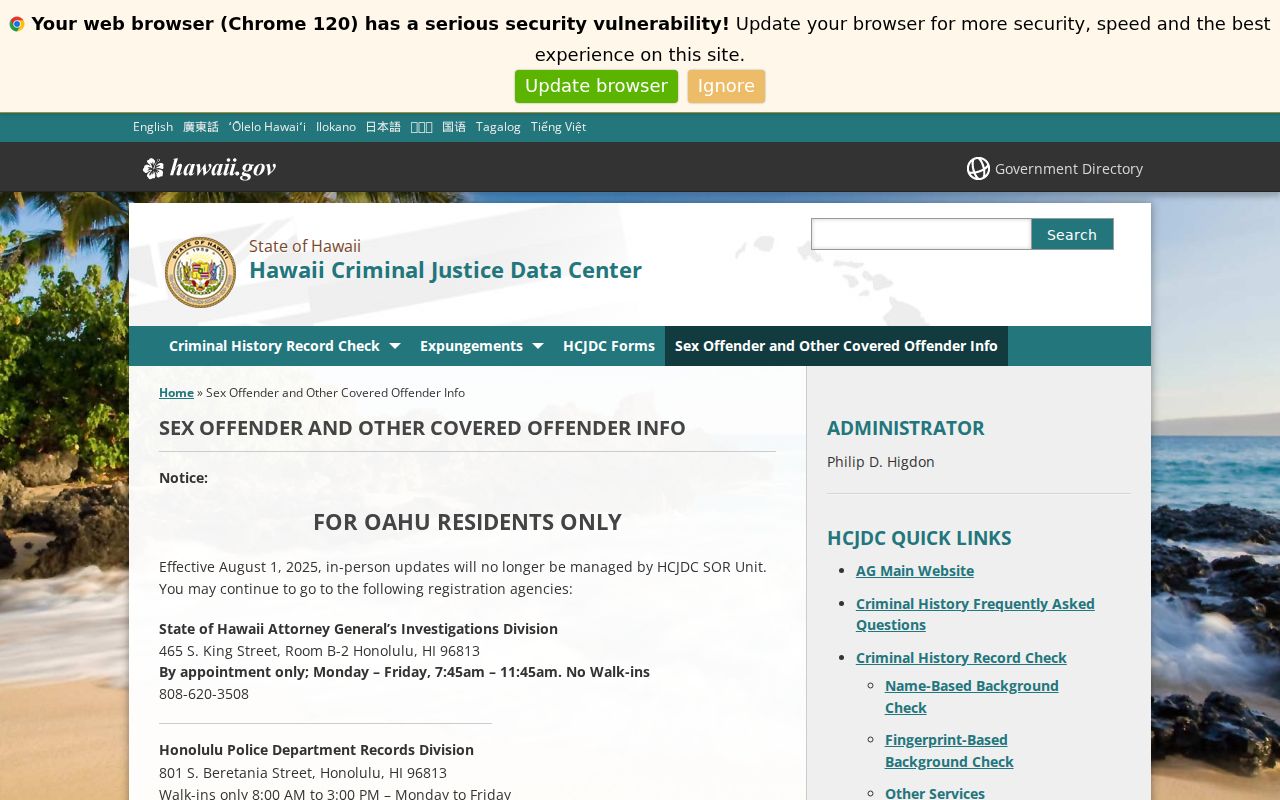
The program page is the right place for registration or compliance questions that a public profile cannot answer.
Searching Hawaiʻi's Covered Offender Registry
The public form supports both identity and place searches. Choose the narrowest reliable criteria. A surname and first name work for a known person. Street, city, ZIP code, and radius controls serve neighborhood awareness. Status filters separate registered, non-compliant, absconded, out-of-state, and incarcerated records. The results can be viewed in the form the live portal offers, including map or list controls when enabled.
- Open the official registry and read its conditions and safety warning.
- Choose an offender type and status, then enter a name or Hawaii County location.
- For an address check, select the street or ZIP criteria and a live radius option.
- Open a possible match and compare aliases, photograph, physical details, address, status, and covered offenses.
| Field Label | Type | Required | Notes |
|---|---|---|---|
| Offender Type | Selection | No | All, Sex Offender, or Offender Against Minor. |
| Covered Offender Status | Selection | No | Includes Registered, Non-Compliant, Absconded, Confirmed Out-of-State, and Incarcerated. |
| First and Last Name | Text | Mode-dependent | First name narrows a surname search. |
| Street Name and City | Text/Selection | Address mode | City is a postal place, not an incorporated jurisdiction. |
| Radius | Selection | Address mode | Select, 1 Mile, 2 Miles, or 3 Miles. |
| ZIP Code | Selection | No | All or a listed statewide ZIP/place value. |
| Search/Clear | Button | Search only | Runs or resets the criteria. |
Registry absence does not prove that a person has no criminal history. It only means the search did not identify a public chapter 846E profile under the criteria used.
Hawaii County Registration Offices
Hawaii County registration is completed through designated police or state sheriff locations. The current state FAQ lists the Hilo Police Station Receiving Desk, 349 Kapiʻolani Street, Hilo, (808) 961-2213, and the Kona Police Station at 74-5221 Queen Kaʻahumanu Highway, Kailua-Kona, (808) 326-4646. It also lists State Sheriffs at Hale Kaulike, 777 Kīlauea Avenue, Hilo, (808) 933-8833, and the Keakealani Building, 79-1020 Haukapila Street, Kealakekua, (808) 322-4847.
General FAQ hours are 8 a.m. to 4 p.m. weekdays except holidays unless a site states otherwise. The Kona police site has since published Hale Mākaʻi Place as its station address, so call before visiting. That source-date conflict is a reason to confirm the current desk rather than relying only on an older address line.
Hilo Police Receiving Desk
349 Kapiʻolani Street
Hilo, HI
(808) 961-2213
HCJDC Registry Program
State registration and compliance questions
(808) 587-3350
What a Registry Profile Shows
A Hawaii County sex offender profile combines identity, location, compliance, and offense information that chapter 846E makes public. A result should be read as a whole. A name alone is not enough, and an address is not proof that every person at that location is registered. The portal may publish statutory registration data such as vehicles only when it is part of the public inventory.
| Name & Aliases | Primary name and other names reported for identity matching. |
|---|---|
| Photo & Physical Description | Photograph, sex, age or date of birth, height, weight, hair and eye color, race, and published marks or tattoos. |
| Registered Address | Public residence or location information authorized for display. |
| Offense & Statute | Covered offense, jurisdiction, conviction date, and statutory description. |
| Registration Dates | Release or registration dates and other public timeline fields. |
| Registration Status | Registered, non-compliant, absconded, confirmed out-of-state, or incarcerated status when shown. |
The profile does not prove present dangerousness. It also does not replace a court docket, eCrim conviction search, or fingerprint-based review of one's own repository record.
Hawaii County and NSOPW
The U.S. Department of Justice National Sex Offender Public Website searches participating jurisdiction registries. It is useful when a name, trip, or address question extends beyond Hawaiʻi. NSOPW does not become the custodian of a Hawaii County registry profile. Hawaiʻi's portal remains authoritative for its record, and differences should be checked with HCJDC.
The national search screen shown below is the cross-state layer, not a replacement for Hawaii County search filters.
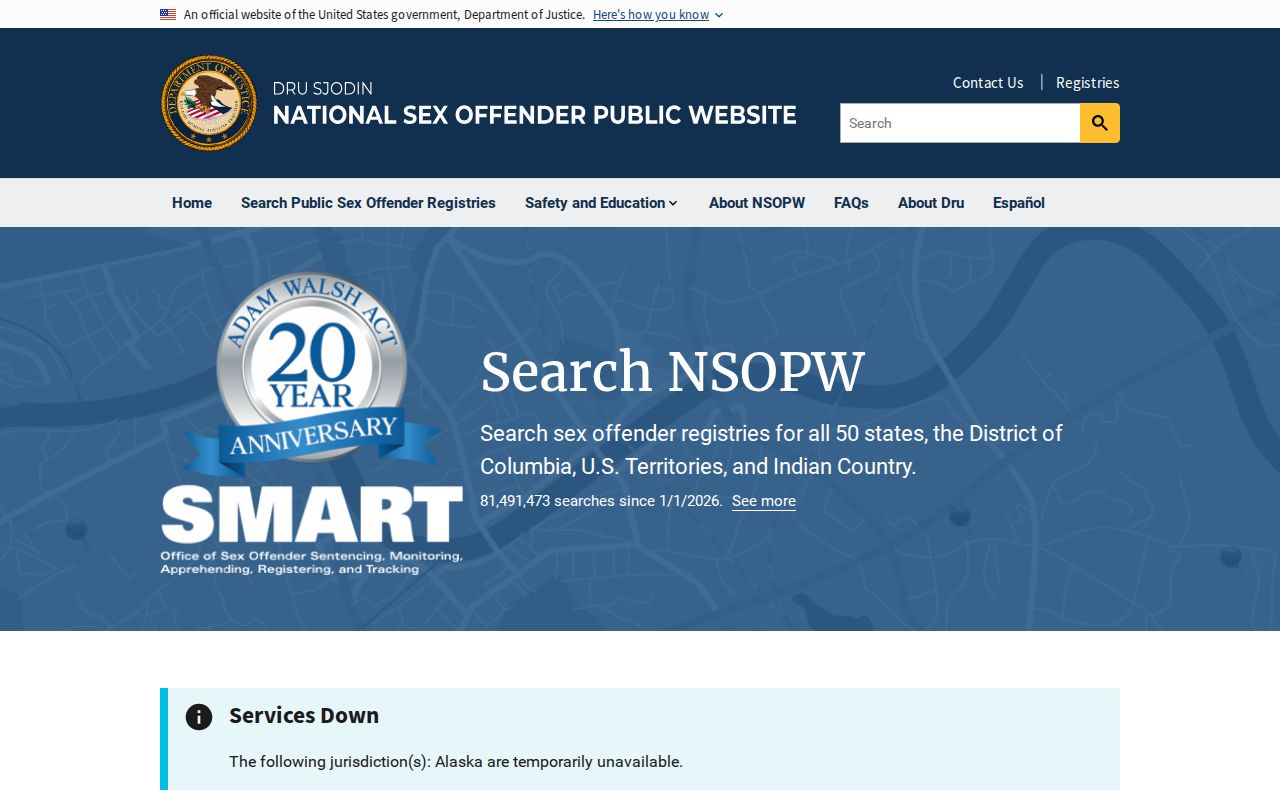
Using both sources can help when a person recently moved or when the relevant location sits outside the state.
For an island-only place search, start with the local registry because it offers Hawaiʻi-specific status and address controls. If the two systems appear to disagree, do not infer compliance or guilt from the mismatch. Call HCJDC at (808) 587-3350 for a state record question.
Registration Requirements and Levels in Hawaii
Hawaiʻi does not publish a simple three-tier chart that maps neatly to generic federal shorthand. Chapter 846E defines covered offenders, registration triggers, update duties, periodic verification, tolling, public access, and ways a duty may end. Duration depends on the offense and the statute. Some people have lifetime duties, while limited categories may petition after the statutory minimum and a required clean period.
| Requirement | Duration or Timing | Public Meaning |
|---|---|---|
| Initial in-person registration | Generally within three working days after an applicable trigger | Applies after such events as arrival, release, conviction without incarceration, probation, or parole placement. |
| Island visitor threshold | More than ten days, or an aggregate thirty days in a calendar year | Can create a registration duty for a covered visitor. |
| Changes and verification | As chapter 846E and current instructions require | Updates may use the signed update form, signed writing, or an approved in-person channel. |
| Lifetime or petition-based duty | Offense and statute dependent | HRS §846E-10 governs termination eligibility; there is no honest universal tier duration. |
The official chapter 846E text controls. Its public-law page is pictured below.
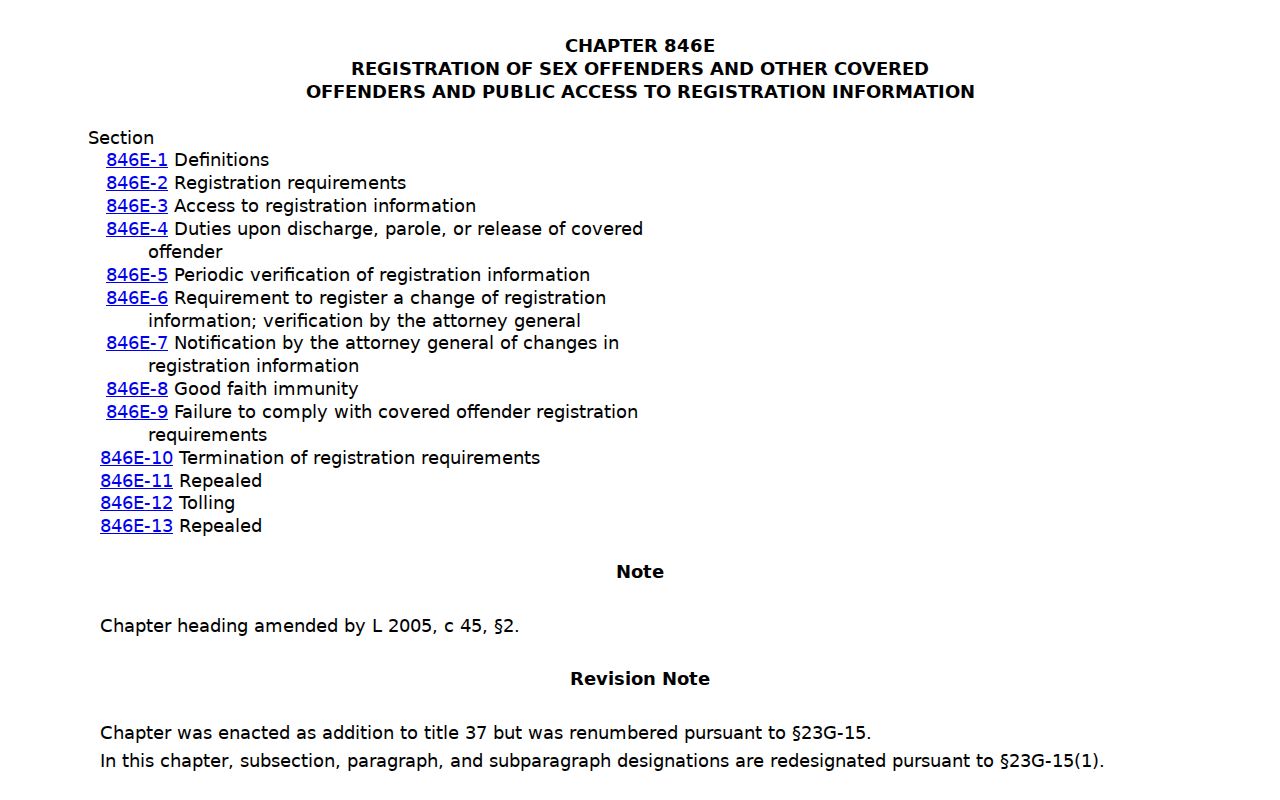
For a person's exact duration or petition eligibility, use the current subsection and case record instead of a generic tier label.
Hawaii County Updates and Alerts
Registration generally follows the earliest applicable statutory trigger, such as arrival in Hawaiʻi, release from custody, conviction when not incarcerated, release on probation, parole placement, or arrival on an island where a covered person expects to remain beyond the visitor threshold. A change can be reported through the signed Covered Offender Registration Update Form, a signed written statement, or an approved in-person method.
An eHawaii.gov account can be used for email alerts. Alerts may be sent when a covered offender updates information or moves into the selected area. This can support community awareness without requiring repeated manual searches. It is still wise to open the current profile because an alert is a notice of a change, not a full case file.
Note: Postal city labels help with place searches, but Hawaii County has no incorporated municipalities or separate city police registries.
Report Hawaii County Noncompliance
A profile status may say non-compliant or absconded, but public users should not investigate or confront the person. Report suspected noncompliance to the Hawaiʻi Police Department or HCJDC. The registry line is (808) 587-3350. Use 911 only for an emergency. Failure to comply with registration duties can be a class C felony under HRS §846E-9, and law enforcement decides how to investigate that offense.
Provide the profile link, reported name, location concern, and a clear account of what prompted the report. Do not trespass, follow someone, publish private household details, or assume that a stale address proves a crime. Agency staff can compare the tip with nonpublic compliance data and current registration instructions.
Lawful Use and Community Notification
Hawaii County registry information is published for safety and community awareness. It can help a family understand a nearby public record, monitor official updates, or check an address area. It does not establish current dangerousness and does not authorize threats, trespass, harassment, vigilantism, or discrimination. The warning and conditions displayed by the official portal govern use of its information.
Use registry data lawfully: Misusing Hawaii County covered-offender information may violate criminal or civil law. Never use it to threaten, harass, intimidate, trespass, or confront a registrant or household.
Community notification works best through official profiles and eHawaii.gov alerts. When the question is broader than registration, use the proper source. A court case explains the prosecution, while a registry record explains a chapter 846E duty. The broader Hawaii County criminal history channels show where those distinct records are kept.