
Criminal Cases in Hawaii County Courts
Hawaii County criminal cases belong to the Hawaiʻi State Judiciary's Third Circuit. The Third Circuit court directory identifies Circuit, District, and Family Court contacts across the island. Circuit Court tries felonies. District Court tries misdemeanors and traffic offenses and conducts preliminary felony proceedings. Adult criminal information from Family Court may also appear when public. There are no municipal courts in Hilo, Kailua-Kona, or Hawaiian Paradise Park, so a searcher should not look for separate city dockets.
The clerk and Legal Documents staff keep the official Hawaii County criminal court file. Police reports remain with the arresting agency, and the prosecutor's file is not a substitute for the court docket. The case file begins when a complaint, information, or indictment is filed. It then records hearings, motions, pleas, judgments, and sentence events. That separation matters because an arrest charge may change before filing or during plea talks.
Hawaii County Circuit 3 IDs
Third Circuit case numbers carry circuit digit 3. The eCourt Kōkua system guidance explains that older migrated numbers must be normalized with a circuit digit, case-type code, and leading zeroes to form a 12-character identifier. Newer JIMS numbers can be entered in their full hyphenated form. A missed digit can make a Hawaii County court case appear absent even when it is public.
The source page below illustrates the official search formats and hours used for Hawaii County criminal case records.
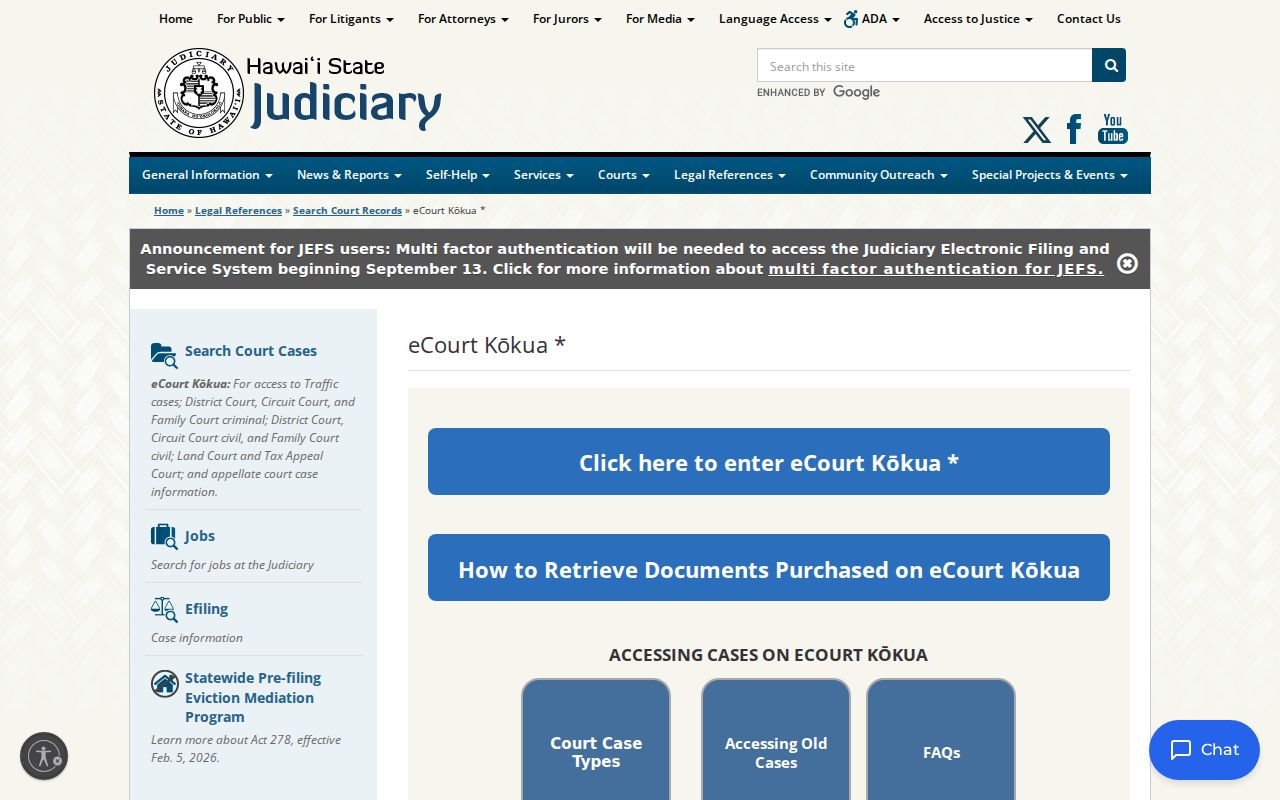
Its format rules are especially useful when a citation or old paper file shows only a short legacy number.
How to Search Case Records
Online Judiciary access provides free case metadata through eCourt Kōkua. Search by a full case ID when possible. A party search is the next best route, but spelling, prior names, and common names can produce incomplete or ambiguous matches. The portal includes a disclaimer and CAPTCHA gate. It covers adult criminal matters in District, Circuit, and Family Court, subject to date and confidentiality limits.
- Open eCourt Kōkua and accept the official disclaimer.
- Choose case-ID mode or party-name mode. Use circuit 3 for an older Hawaii County case number.
- Enter the full ID, or search the last or business name and add a first name to narrow the list.
- Open the matching case and review Parties, Events, Offenses, status, and upcoming hearing information.
- Buy an eligible PDF or contact Third Circuit Legal Documents for a copy, certification, or older file.
| Field Label | Type | Required | Notes |
|---|---|---|---|
| Case ID | Text | Case-ID mode | Use the complete normalized ID; circuit 3 identifies the Third Circuit. |
| Last/Business Name | Text | Party mode | Exact spelling affects results. |
| First Name | Text | No | Narrows an individual party search. |
| Case Type/Court | Selection | Mode-dependent | Includes District, Circuit, and Family criminal categories. |
| CAPTCHA/Disclaimer | Security control | Yes | Must be completed before searching. |
| Search or Reset | Button | Search only | Runs or clears the query. |
The official overview shown below distinguishes free case information from documents that carry a purchase icon.
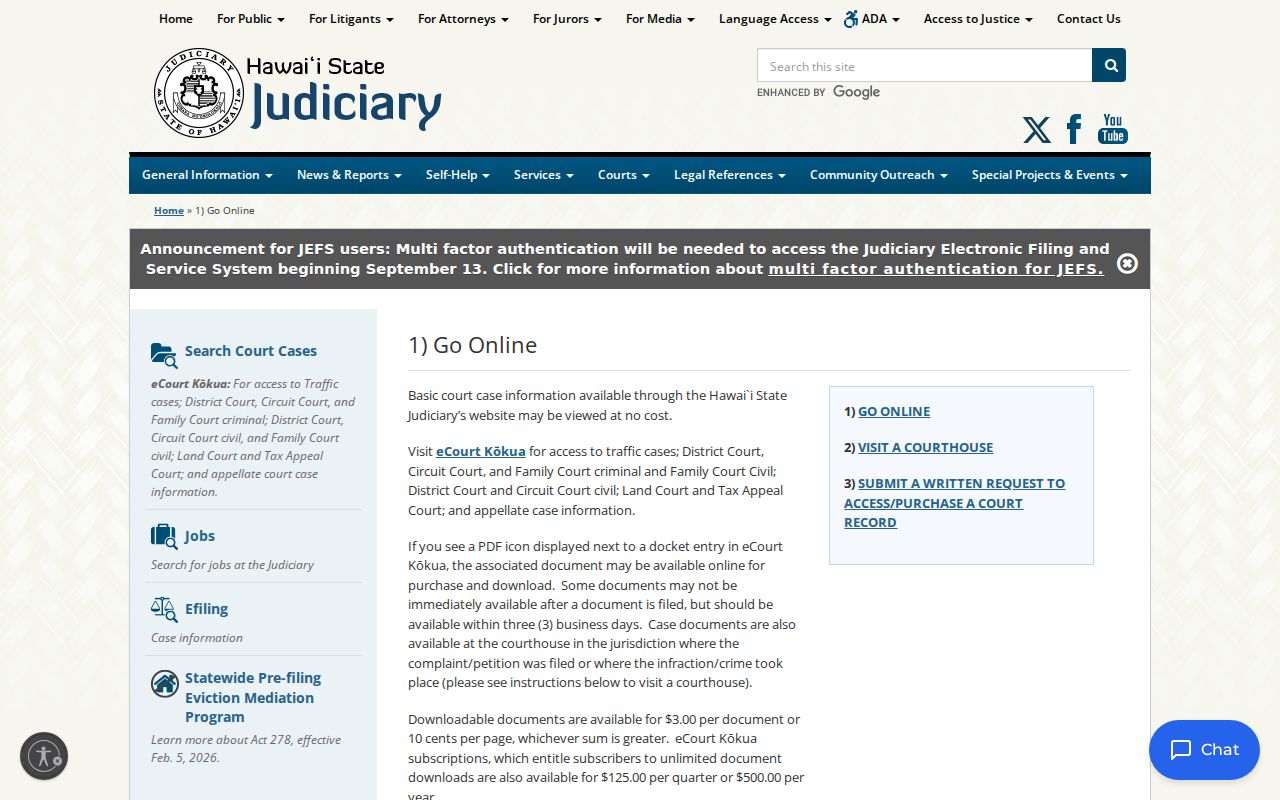
Use the docket metadata to identify the precise filing before paying for a document.
Hawaii County PDFs or Terminals
A PDF icon does not mean that every part of a Hawaii County court case is free to download. It means an eligible document can be purchased. Online PDFs cost $3 or ten cents per page, whichever is greater. New filings may take up to three business days to appear. A subscription is available, but most occasional searchers can inspect free metadata first and purchase only the complaint, judgment, or other paper they need.
Courthouse terminals provide a no-cost viewing option. Judiciary courthouse access instructions describe the public terminals and records counters. In Hilo, terminals are available near Legal Documents and the Law Library. They operate first-come, first-served, generally from 7:45 a.m. to 3 p.m. Files more than five years old may be offsite, so call before traveling. Multiple files, microfilm, and offsite retrieval can take longer.
The courthouse access page shown here is the official fallback when a Hawaii County criminal case document is not offered online.
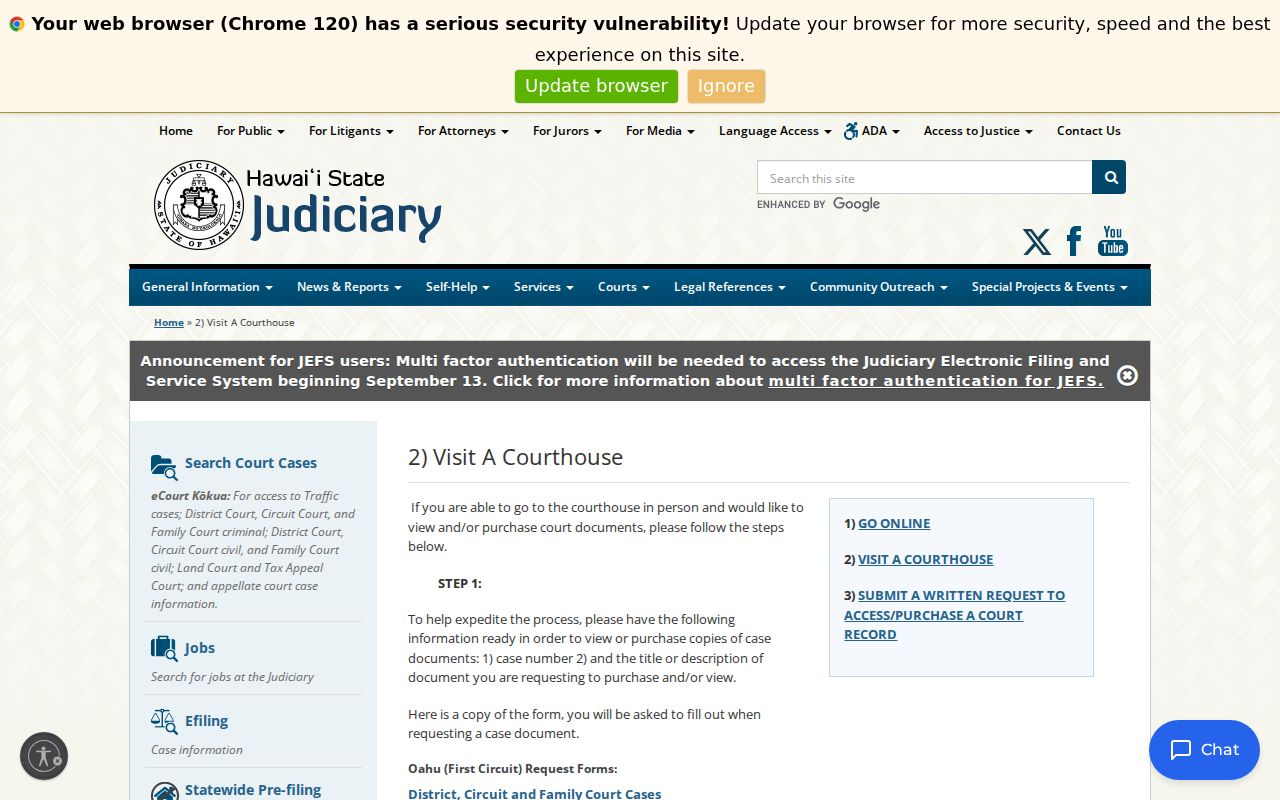
Terminal viewing and staff-assisted retrieval can expose the public part of a file without treating the web index as complete.
What the Case File Shows
A Hawaii County criminal court file links the filed charge to the acts taken by the court. It can show whether the State of Hawaiʻi filed a complaint, information, or indictment; how the defendant pleaded; what motions were set; and how each count ended. A docket entry is an index line, not always the underlying document. Read the text, then inspect or buy the filing when its exact wording matters.
| Case Number & Court | Case ID, Third Circuit division, case type, title, filing date, and status. |
|---|---|
| Charging Document | Counts, alleged offenses, statute descriptions, and offense levels filed by the State. |
| Docket Entries | Sequence, date, event text, motions, notices, warrants, and filed-document icons. |
| Hearing Dates | Date, time, location, judge, and public upcoming-hearing information. |
| Disposition & Judgment | Plea, acquittal, dismissal, judgment, and the result for each count. |
| Sentence & Conditions | Sentence entries, probation orders, commitment, and financial assessments made public. |
Protected identifiers, sealed filings, juvenile records, and confidential events do not appear in the public view. Counsel of record and related or appeal identifiers may appear when public.
Read Hawaii County Docket Codes
Hawaii County court records use short event labels that can be easy to misread. The current eCourt Kōkua manual identifies case-level tabs for Parties, Events, Offenses, and Upcoming Court Hearing. Schedules can change, so the filed notice or direct confirmation from the court controls. Restricted events remain hidden.
- AP
- Arraignment and plea, the hearing where the charge is stated and a plea is entered.
- ACQ or ACQB
- Acquitted, including an acquittal after a bench trial when coded ACQB.
- ARF
- Arrest report filed in the case docket.
- BBP or BCP
- Bail bond posted or bond cash posted.
- BAR
- Bond amount reduced.
Other plain-language entries include preliminary hearing, arraignment and plea, change of plea, judgment, sentence, warrant issued or recalled, and appeal notice. “Dismissed” is a result for a case or count. It does not itself erase the arrest cycle or remove all public docket data.
Stages of a Hawaii County Criminal Case
A filed Hawaii County criminal case moves through steps that depend on the charge and how the matter resolves. District Court may handle a felony's first appearance and preliminary stage before Circuit Court proceedings. A misdemeanor can remain in District Court. Motions, continuances, or a change of plea may add events, so the docket is a timeline rather than a promise of fixed timing.
Case flow: Charges Filed › Arraignment › Pretrial › Plea or Trial › Disposition › Sentencing
Booking language is not final court language. Prosecutors may decline a count, amend it, or file a different statutory charge. A no-contest plea may still result in a conviction judgment, while an acquittal or dismissal has a different legal effect.
Hawaii County Records Counters
East and West Hawaiʻi have separate places to retrieve Third Circuit records. Hilo Legal Documents is at Hale Kaulike, 777 Kīlauea Avenue, Hilo, and can be reached at (808) 961-7400. West Hawaiʻi records route through Keahuolū Courthouse, 74-5451 Kamakaʻeha Avenue, Kailua-Kona. The Judiciary directory should be checked for the current division number before a visit or mailed request.
A written request should identify the court, full case ID, parties, document title and date, whether certification is needed, delivery method, and requester contact details. Older South Kohala matters may route through the appropriate Third Circuit branch rather than a city clerk. Court staff can explain access and copy procedures, but they do not interpret the record or give legal advice.
The official Third Circuit directory pictured below helps route a Hawaii County criminal court case request to the right island office.
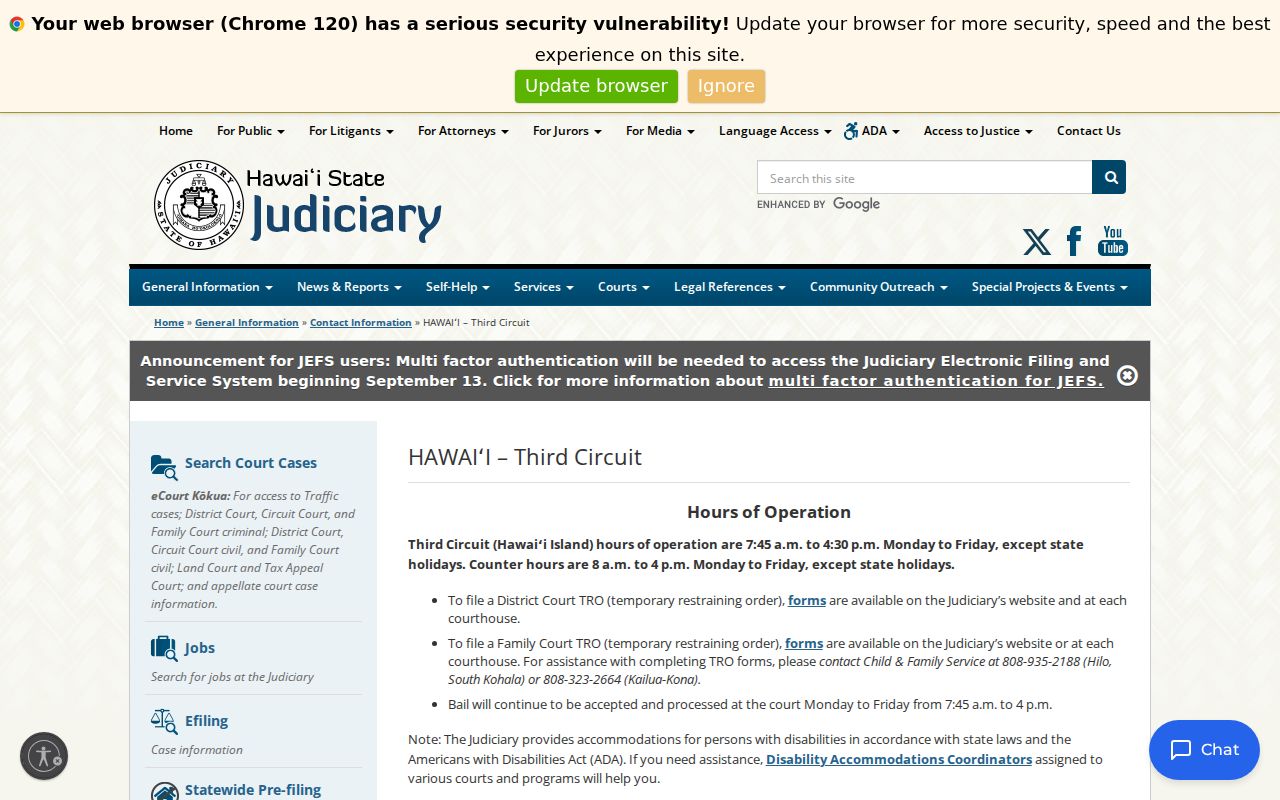
Calling first is prudent when a file may be stored offsite or the request covers several documents.
Hawaii County Federal Court Cases
Not every prosecution tied to Hawaiʻi Island belongs in the Third Circuit. Federal drug, firearms, public-corruption, customs, federal-land, and interstate-commerce cases can be filed in the U.S. District Court for the District of Hawaiʻi. Those records are searched through PACER, not eCourt Kōkua. The federal trial court is based in Honolulu, even when the conduct or defendant has a Hawaii County connection.
A blank Third Circuit result may therefore call for a federal search, but the systems should not be blended. PACER holds the federal docket and filed papers. The U.S. District Court for the District of Hawaiʻi supplies court contacts. Federal custody is yet another record layer, and a pretrial detainee may not appear in the Bureau of Prisons locator.
Case Record Access and Restrictions
Public access to Hawaii County court records is governed by Judiciary rules and orders as well as Hawaiʻi law. The Judiciary records rules distinguish open records from sealed or restricted material. Juvenile matters, protected addresses, personal identifiers, confidential filings, and some victim information may be withheld or redacted. An online absence may mean the matter is too old for portal coverage, sealed, confidential, misspelled, or not yet filed.
District criminal coverage generally begins in August 2012. For an older Hawaii County criminal case, contact Legal Documents instead of treating a blank result as proof that no case exists. Under the Uniform Information Practices Act, public access remains subject to privacy and other-law limits. Court-specific rules also control court files.
Separate systems: An HCJDC expungement certificate does not automatically remove a Judiciary case from eCourt Kōkua. Court sealing requires the court's authority.
When a record appears wrong, compare the filed judgment with the docket. A correction at the court may not update the Hawaii Criminal Justice Data Center automatically. For a broader explanation of how the systems connect, use the Hawaii County criminal history overview.